OFFICE
The Personal Injury Lawyers ™
77 W. Wacker Drive STE 4500
Chicago, IL 60601

Free Consultation 312-999-9990




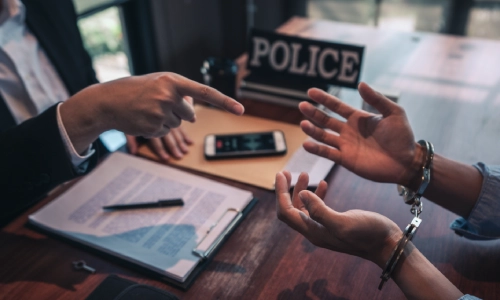
Civil rights are rights guaranteed to all citizens under the U.S. Constitution. In the context of encounters with police, the term specifically refers to rights under the Fourth and Fourteenth amendments.
Police misconduct refers to any situation wherein officers of the law abuse their power beyond their authority. This is most commonly observed as false arrests, racial profiling, or, as we will discuss today, the exercise of excessive force.
If you know your legal rights when any of these events happen to you, you stand the best chance of holding and achieving justice.
Excessive force is what happens when a police officer uses physical means or power more than is necessary to interact with an individual (typically, though not always, a suspect). In this case, “necessary” is not what the officer believed or intended, but rather whether the force would have been objectively reasonable in the exact moment it was applied.
Courts consider multiple factors when determining whether an encounter constitutes excessive use of force. These factors include, but are not limited to the following:
Generally speaking, the greater the degree to which each of these or any similar factors is present, the more force is warranted. Conversely, a compliant suspect means that a police officer should also exercise a greater level of restraint.
There are both overt and subtle displays of excessive force. The severe end of the spectrum includes media headliners such as extrajudicial shootings, chokeholds that lead to death, or unjustified blows to the head.
In the middle of the pack would be mace and tasers, which, while technically non-lethal, can still be considered excessive force if applied unnecessarily, such as in the case of suspects who are already restrained.
Finally, actions that are not actively aggressive but can cause unnecessary pain may also be considered excessive. Such a case might include overly tight handcuffs on a person suffering from gout.
Realistically, any encounter with law enforcement requires some execution of authority on the officer’s part. As a result, any encounter with law enforcement can involve excessive force.
Excessive force might be more associated with dramatic life-and-death confrontations, but because these situations involve dangerous and aggressively resisting suspects, force is often justified. Instead, true cases of excessive force arise more frequently in routine encounters.
For example, if a person is stopped on the highway and does not resist, but is then pushed against their car and handcuffed harshly despite posing no threat, then this would be a clear depiction of excessive force. Alternatively, if a person is trespassed and is dragged out of the house when they can, and have agreed to walk, again, excessive force is present.
That is, of course, not to say that police misconduct via excessive force cannot occur in more charged or high-profile scenarios. It often surfaces in protests, for example, where less-lethal crowd control tools might be used with less restraint than they should, and thus lead to unneeded pain, injuries, and trauma for large crowds of people.
In 1989, a man named Dethorne Graham experienced an insulin reaction and requested a friend to drive him to a local convenience store to buy orange juice. Upon entering the store, however, they found that the line was too long and left.
Graham and his friend were stopped by Officer Connor, who observed Graham’s erratic behavior caused by his condition and became suspicious. The situation escalated to the point that other officers arrived on the scene before Connor confirmed from the store that Graham had not done anything wrong.
The encounter led to Graham suffering several injuries, and he pursued a lawsuit.
Initially, the lower courts ruled in favor of the officers, applying a four-part “substantive due process test.” Graham then appealed to the Supreme Court, which ordered that the case be sent back to the lower courts to reevaluate it under the Fourth Amendment’s objective reasonableness standard.
The case did not lead to a clear victory for Graham: while the Supreme Court’s ruling was a win for Graham’s legal argument (that Connor’s exercise of force was not objectively reasonable), he did not get a ruling that his rights were violated. That said, the case settled out of court, and Graham received an undisclosed amount for the damages he suffered.
Regardless of the outcome, the case is now the foundation for determining whether or not an officer’s actions constitute excessive force.
The Fourth Amendment is a protection against unreasonable seizures and serves as the grounds on which most excessive force cases are built.
The ruling of Graham v Connor set that:
To put it simply, the question as established is: given the facts known at the time, would a similarly trained and experienced officer respond in a similar fashion?
In situations where a person is already detained, jailed, or otherwise in police custody, the Fourteenth Amendment provides protection. Specifically, the Amendment’s Due Process Clause diminishes the ability of an officer to justify any degree of force once a person is under their control.
Most forms of violence against a person who is under control are considered unnecessary, and any such action is deemed a constitutional violation.
Section 1983 is a federal statute that grants people the right to file lawsuits against police officers and government agencies acting “under color of the law.” The phrase refers to government officials using power granted to them by the government.
While federal law grants a right to pursue justice, it does not set a time limit for doing so. Federal courts tend to borrow the statute of limitations for personal injury claims from the state where the excessive force violation happened.
Claims brought under Section 1983 can, but not always, lead to broader revelations of systemic issues in the police force. Poor training, bad supervision, or entire precincts engaging in misconduct are, sadly, not uncommon discoveries in such cases.
Proving that your civil rights were violated requires both evidence and an awareness of your own actions from the moment you interact with the officer. Strong cases require clear and well-preserved proof and accounts of the event that show you were acting reasonably and they were not.
The experienced attorneys at The Personal Injury Lawyers™ have successfully held law enforcement accountable in courtrooms across the country, recovering fair compensation for victims of brutality and wrongful treatment. We offer free, no-obligation consultations and will fight tirelessly to get you the justice and compensation you deserve.
Don’t let the statute of limitations run out! Call us today at 312-999-9990 to start your claim and take the first step toward holding the responsible parties accountable.







Find out why so many clients appreciate the amount of work we put into their case. You can learn about your options during a free consultation by calling 312-999-9990 or completing our online intake form. We represent Illinois clients from our downtown Chicago office location.
The Personal Injury Lawyers ™
77 W. Wacker Drive STE 4500
Chicago, IL 60601
Free Consultation 312-999-9990
Fax 312-471-8872
