OFFICE
The Personal Injury Lawyers ™
77 W. Wacker Drive STE 4500
Chicago, IL 60601

Free Consultation 312-999-9990

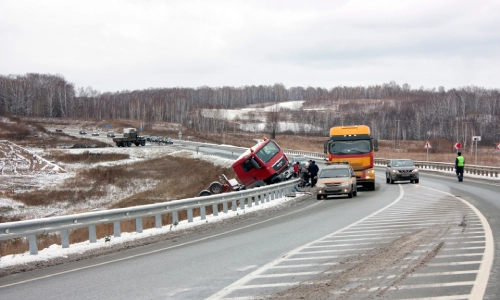
Rear-end collisions account for the majority of truck accidents, making up just about 22% of large truck accident cases, according to the FMCSA’s Large Truck Crash Causation Study. The study is limited to vehicles with a gross weight rating of over 10,000 lbs, but the data can be assumed to hold true for smaller trucks, given that rear-end accidents are also the most common across most vehicle types.
Be it a rear-end collision or some other accident involving a truck, The Personal Injury Lawyers™ have the information you need to move forward from disaster.
The reason rear-enders are so common mostly comes down to the physics of a four-wheeled vehicle —in this case, a truck. There are other factors that contribute, of course, so let’s go through each of them.
Long stopping distances lead to rear-enders, where a truck strikes the back of another vehicle.
Tractor-trailers operating on the highway can weigh upwards of 80,000 lbs and travel at 65 miles per hour. Under ideal conditions, this translates to about 525 ft to come to a complete stop.
For context, that number is twice the stopping distance of the average car going at the same speed. Again, these are ideal numbers, meaning if road conditions are hazardous, these distances can increase to absurd lengths.
Blind spots, in contrast, contribute to rear-end collisions in which other vehicles strike the back of the truck or its trailer.
Because trucks are designed primarily to carry cargo, they tend to have less visibility than other vehicle types. Most trucks rely on arrays of side mirrors to see behind them, since there is no rear-view mirror.
Larger trucks suffer from this problem the most; the higher up the cab is, the farther an operator can see, but the more difficult it is to track vehicles close to the truck. It takes one badly timed brake for traffic behind the truck to slam into it.
Some modern trucks may have rear-facing cameras or even radar, but neither is standardized or universal.
Of course, the first two factors do not cause accidents on their own. A truck’s mass and volume give it the potential to lead to an accident, but the most common trigger is driver negligence.
Keep in mind that driver negligence might apply to other vehicle operators besides that of the truck. This is especially true in the case of multiple vehicle accidents.
Beyond the typical rear-ender, there are several other accident types that are either unique to or more common in truck accidents by nature of a truck being the vehicle that it is. Note that this is not a comprehensive list of all possible truck accidents; rather, it is a list of frequent ones.
A jackknife accident is what happens when a truck’s trailer swings out at a 90-degree angle. They are so named because the way the motion looks resembles that of a jackknife blade flicking outward from its handle.
Jackknife accidents happen when the truck cab decelerates faster than the trailer. If the load in the trailer is heavier on one side than the other, the momentum on that side can push the entire structure outward.
These accidents are most common on slippery surfaces where a trailer’s brakes may not be as effective as those of the cab.
A rollover accident occurs when a top-heavy vehicle flips over, often during a turn. Perhaps the most at-risk type of trucks when it comes to rollover accidents are tankers, whose liquid cargo sloshes around with a high center of gravity.
Rollovers are some of the deadliest types of truck accidents, but thankfully, they are also less frequent by comparison.
Every vehicle has “no-zones,” which are the blind spots immediately next to it. The larger the vehicle, the larger the blind spot, and trucks can get very, very large indeed.
Blind spot collisions occur when smaller vehicles in these no-zones end up making contact with the truck, usually because of a lane change or an attempt to overtake.
Wide turn collisions are closely related to blind spot collisions, but exclusively occur, as the name suggests, during turns.
Longer vehicles need more space to execute a turn, necessitating a swing in the opposite direction in order to stay within the road’s boundaries. Unfortunately, this also creates false windows of opportunity for bad drivers to squeeze through without realizing the truck is about to sweep back.
This creates a scenario where smaller vehicles, at best, get trapped, and at worst, get crushed between the truck and a stationary object.
Every single vehicle on the road can suffer a tire blowout at any time, even on a set of brand-new tires. All it takes is for the unfortunate vehicle to meet the wrong conditions.
The scary part about blowouts is that they often don’t stop at just being blowouts. In the case of large trucks, they lead to a loss of control, which in turn opens the possibility of other accidents on this list.
Perhaps the accident most associated with tractor-trailers (and also perhaps the most terrifying), underride accidents are situations where smaller vehicles end up colliding with a truck trailer with enough force to slide under it.
The typical long-haul truck has between 38 to 42 inches of ground clearance underneath its trailer. The typical sedan is about 56 inches tall at the roofline, with its hood height about 32 inches off the ground.
Put those numbers side-by-side. A car’s front end will often have enough clearance to slide directly beneath a trailer, meaning no engine block or crumple zones can offer protection.
Determining fault in any truck accident case, really, and not just rear-end ones, is often more complex than in typical car accidents because multiple parties may share responsibility. The truck driver may be directly liable for negligent actions such as speeding, distracted driving, or violating traffic laws.
Having said that, trucking companies can also be held liable under several legal theories.
Federal Motor Carrier Safety Regulations impose strict requirements on trucking companies regarding driver training, vehicle maintenance, hours of service compliance, and cargo securement. When companies fail to meet these standards, they can be held liable for negligent hiring, negligent retention, inadequate training, or failing to properly maintain their fleet.
Companies may also be vicariously liable for their drivers’ actions under the legal doctrine of respondeat superior, which holds employers responsible for employee actions performed within the scope of employment.
Modern truck accident investigations rely on multiple forms of evidence.
The information provided by these devices can conclusively establish whether a driver was speeding, failed to brake, or took other actions that contributed to the accident. Additional evidence includes maintenance records, driver qualification files, cargo loading documentation, and witness statements.
Between insurance adjusters, medical bills, and the complexity of federal trucking laws, these cases can overwhelm even the most level-headed people. The Personal Injury Lawyers™ understand what’s at stake — your health, your livelihood, and your peace of mind — and we know how to fight for the full compensation you deserve.
Our team has years of experience investigating truck crashes, negotiating with carriers, and holding negligent drivers and companies accountable. Let us handle the legal weight so you can focus on recovery.
Contact The Personal Injury Lawyers™ today at (312) 999-9990 for a free consultation, and take the first step toward justice and rebuilding your life.
The Personal Injury Lawyers ™
77 W. Wacker Drive STE 4500
Chicago, IL 60601
Free Consultation 312-999-9990
Fax 312-471-8872
