OFFICE
The Personal Injury Lawyers ™
77 W. Wacker Drive STE 4500
Chicago, IL 60601

Free Consultation 312-999-9990


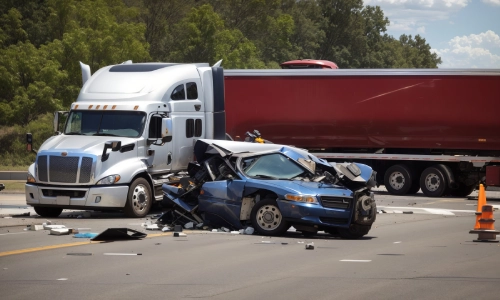
The steps to take after a truck accident largely follow the same rules as other road accidents, but with additional consideration for factors unique to large vehicles. Trucks, even lighter ones, tend to be larger than other vehicles on the road, and so accidents involving them tend to involve more grievous injuries, more costly damages, and more complicated legislation.
Our attorneys at The Personal Injury Lawyers™ have seen and handled truck accident cases involving everything from light pickup trucks to semi-trailers. We know what course of action maximizes victims’ chances of securing fair compensation after a crash.
The specific steps you should take after a truck accident will vary to a certain extent depending on the situation you are in. However, we can easily classify any course of action into three general categories based on its purpose.
That is, to prioritise your safety, to get help, and to gather information.
The first thing to do is to ensure that you personally are safe. Check yourself for any injuries before tending to anyone else, and get away from any source of danger, such as your car itself, or in some cases, hazardous cargo the truck may have been transporting.
Once you know you’re safe, you can turn your attention to your vehicle. You will want to turn on your hazard lights and move the vehicle out of the way of traffic as a precaution against additional collisions, but if this is not possible, you will have to wait for emergency services to arrive.
There are, of course, times when you cannot leave the vehicle. If you find yourself trapped, keep yourself fastened in your seat, call for the attention of anyone nearby, and wait for help to arrive.
Finally, regarding helping other individuals at the scene, do not attempt to move other people if they are trapped or unconscious, or if you do not have the proper training to do so. This is because you risk exacerbating their condition or placing yourself back in danger.
The exception to this is if there is an immediate threat to the person’s life, such as a fire.
Call 911 as soon as you are able, even if no one initially appears injured. Request both police and medical responders, plus fire response if necessary.
Do not assume someone else will call emergency services for you. It is preferable that operators receive multiple calls regarding the same emergency than for them to receive none at all.
If you explained to the 911 operator that the event was a commercial truck accident, they may prompt additional resources to send to the scene. When emergency services arrive, calmly report your version of events, but avoid speculative remarks, as this may lead to an inaccurate account of the accident.
If you have the ability to do so, start taking photographs and video recordings of the scene. Make sure to document relevant information, including the damage to your vehicle, any injuries you sustained, road and weather conditions, and traffic signs, in order to help authorities build a clear picture of the events that transpired.
If you do not have a camera or phone with which to record the scene, you may request help from the authorities to source video from traffic cameras, doorbell cameras, or bystanders who may have been present.
Make sure that the paramedics check you for injuries even if you feel fine. This isn’t just for the eventual insurance claim, but also is an important step in ruling out the possibility of any injuries that might not present symptoms immediately after the accident.
You will also want to visit a doctor after leaving the scene of the accident. You do not necessarily have to accept an expensive ambulance ride and emergency room visit (though insurance will usually cover the cost if you make a successful claim), but you should at least schedule a checkup when you are able.
There are still things to consider when you leave the scene of an accident that can affect how smoothly your claim might go. The next steps involve interacting with the necessary parties in order to build a strong base for any legal or insurance options you might intend to take.
As mentioned earlier, the most important thing to do after leaving the scene is to get a medical assessment. Whether via ER visit or independent checkup, medical reports provide substantial evidence to support your claim.
Even if it turns out you don’t have any injuries, a medical report can still support your side of the story if other drivers try to shift blame to you. As a form of official documentation, it helps push the idea that you sought prompt care and took the incident seriously.
Medical reports can also help establish the timeline of events, which may come in useful if you experience delayed pain or if hidden injuries emerge later on.
You are required to report a car accident after it happens. The laws that require you to do so vary across states and have certain conditions depending on where you are (damage thresholds, injuries, etc.).
In most cases, you will have to file a report with the state DMV. Oftentimes, you may not need to file a report yourself if local law enforcement responded to the scene (which is usually the case).
Some states will require you to report to the DMV only in the event of death or if damages exceed $500.
Regardless, you want to make sure a copy of the police report is available for when you do file your claim. Police reports might not always be a 100% factual account, but they are usually the first official account of an accident and thus serve as a foundation for strong claims.
Most insurance policies have a clause that requires timely notification in order to file a claim, so inform your provider when you can. These clauses are usually shorter than statutes of limitations for personal injury claims, and will win out unless state law explicitly provides a legal right to file a claim before the statute of limitations expires.
Just as when reporting to the authorities, present the basic facts and do not volunteer information unless prompted or until you have complete information.
More than most road accidents, truck crashes tend to involve serious injuries and complicated liability issues. The second point is especially true because of how multiple parties can be involved, all trying to shift blame on each other.
Drivers may try to point at the truck operator, who then expects the trucking company to be liable for damages under respondeat superior, who may themselves point at loading companies, or at truck part manufacturers, or even back at the truck operator. Sometimes, multiple parties may collude and wash their hands of responsibility altogether by blaming bad infrastructure.
Thankfully, truck accident lawyers often offer free consultations, so just by contacting an attorney, you can already eliminate much of this confusion. At The Personal Injury Lawyers™, we also operate on contingency, so we make sure legal representation is accessible even under the financial pressure of a truck accident.
There are several things to keep in mind, no matter what step you are currently on. Here is a quick list of dos and don’ts when dealing with pursuing compensation after a truck accident.
In addition to any photo and video evidence, you may need to gather additional information relevant to the event. The following items can help authorities piece together the sequence of events that led up to a crash, or at the very least help accurately determine liability for the purposes of an insurance claim.
When you’re facing the aftermath of a truck accident, secure the help of our truck accident attorneys at The Personal Injury Lawyers™. Our legal advocates are ready to fight by your side to protect your rights.
Truck accidents are some of the most frightening events on the road, but with our aid, you can preserve evidence and pursue the compensation you deserve. Call The Personal Injury Lawyers™ today at (312) 999-9990.
The Personal Injury Lawyers ™
77 W. Wacker Drive STE 4500
Chicago, IL 60601
Free Consultation 312-999-9990
Fax 312-471-8872
